
February 11, 2026
How to Stay Organized with the Zendo Eisenhower Matrix Calendar
If your to-do list keeps growing, and there's no progress, when urgent, important, and minor tasks are mixed, everything feels pressing, which creates stress and scattered focus. The Zendo Eisenhower Matrix solves this by sorting tasks into four categories: Urgent and Important Important but Not Urgent Urgent but Not Important Not Urgent and Not Important By organizing tasks this way, decision-making becomes easier, stress decreases, and real progress becomes visible. Structure, not more effort, is the missing piece.
Have you ever created a to-do list that keeps piling up, yet at the end of the day, there is no clear progress? So much effort goes into trying to stay on top of everything, and still, there is uncertainty about what actually moved forward.
Many people experience this. The list gets longer.
The pressure increases. The mind stays tense. Movement happens, but it feels like there's no progress.
That feeling is exhausting, and you are not alone.
Why Your To-Do List Feels Overwhelming
Most to-do lists are long, and they end up feeling like a brain dump.
You start getting overwhelmed with random tasks like:
- Urgent emails besides long-term goals
- Small errands competing with meaningful projects
- Minor requests sit next to serious responsibilities
When everything feels urgent, the mind stays in a constant state of tension.
What Is the Zendo Eisenhower Matrix?
The Zendo Eisenhower Matrix is a structured way to sort tasks based on urgency and importance.
Instead of asking, What should be done next?
Ask two clear questions:
- Is this important?
- Is this urgent?
Those two questions divide tasks into four clear quadrants.
The Four Quadrants
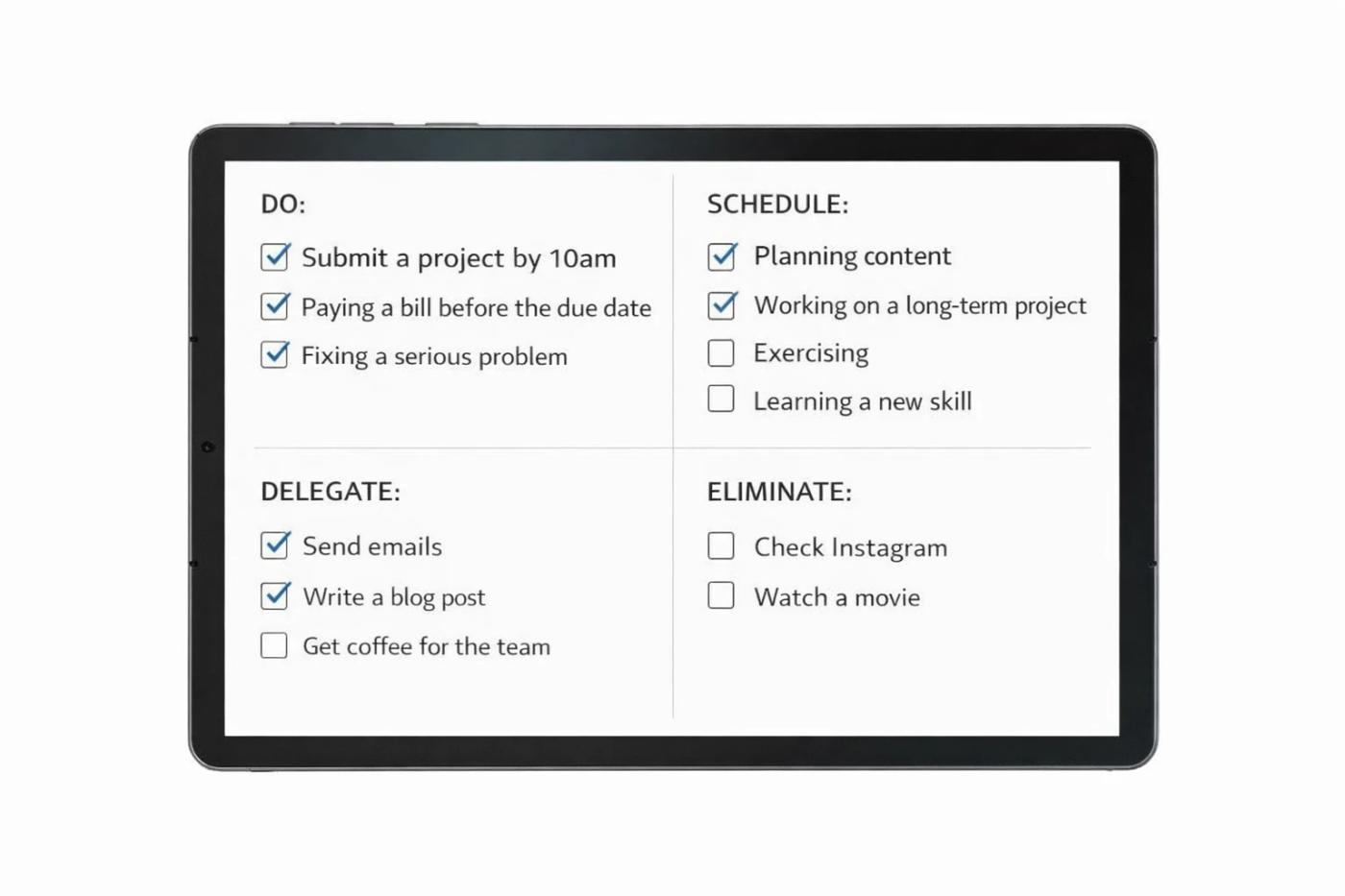
Urgent and Important (Do)
These tasks have deadlines and real consequences.
Examples:
- Client work is due today
- Paying a bill before the due date
- Fixing a serious problem
These deserve immediate attention.
This list should stay small.
Choose 3 to 5 maximum tasks per day.
If everything feels urgent, something is not being planned properly.
Important but Not Urgent (Schedule)
This is where real growth lives.
Examples:
- Planning content
- Working on a long-term project
- Exercising
- Learning a new skill
Nothing bad happens today if these are ignored.
That is why they are often postponed.
Urgent but Not Important (Delegate)
These tasks feel loud but do not create long-term value.
Examples:
- Non-essential messages
- Minor requests
- Interruptions
Delegate when possible.
If delegation is not possible, limit the time given to them.
Not Urgent and Not Important (Eliminate)
These are distractions.
Examples:
- Endless scrolling
- Rechecking notifications
- Tasks added out of guilt
Some tasks should not be on the list at all.
How to Create a Structured To-Do List with the Zendo Eisenhower Matrix
Step 1: Empty your mind
Write down all tasks in one place.
Do not organize yet.
Just release everything onto paper or into one app.
This alone reduces mental pressure.
Step 2: Sort into the four quadrants
Place each task into:
- Do
- Schedule
- Delegate
- Eliminate
Ask:
- Does this truly matter?
- Does this truly need to happen today?
If the answer is no to both, remove it.
Step 3: Focus on one quadrant at a time
Start with an urgent and important task.
Then move to scheduled important tasks.
Do not jump between sections.
Multitasking increases stress and weakens focus.
Step 4: Limit the “do now” list
Keep urgent and important tasks to 3–5 per day.
A short list builds momentum.
A long list creates anxiety.
Why This Works
This system removes emotional decision-making.
Instead of reacting all day, there is a structure to follow.
Instead of asking repeatedly what to do next, there is certainty.
That quiet certainty reduces stress more than expected.
If your to-do list has been overwhelming, scattered, and heavy, this method offers relief. The Zendo Eisenhower Matrix gives tasks a clear place, and once tasks have a clear place, progress becomes visible again.